
Reviewed · CITY PASSES
Universalmuseum Joanneum Pass in Graz
If you like museums but hate over-planning, this pass makes Graz and Styria feel flexible. I like that you pick a 24- or 48-hour window, and it covers 12 different museums and cultural institutions.
My favorite part is how practical it is for a real visit. You can mix big-ticket stops like Eggenberg Palace and the Styrian Armoury with smaller, more personal museums, then slow down when something grabs you. One thing to watch: there are no guided tours included, and some visitor support is extra, so plan on self-guiding your route.
Also, it’s a paper ticket system, so don’t rely on a QR code showing up in your inbox at the last minute. Print your booking confirmation and show it at the cashier point when you receive the pass, then you’re good to go.
Key things to know before you go
- Choose 24 or 48 hours: You control how many sites you fit, not some rigid tour schedule
- 12 admissions in one pass: spread across Graz and Styria, so you can build a mix of themes
- A self-guided format: guided tours are sold separately if you want a teacher in the room
- Big draws + smaller detours: palace interiors, historical weapons, Roman finds, contemporary art, and nature-focused exhibits
- Family-friendly option: the Austrian Sculpture Park is designed to be relaxing and child-friendly
- Ticket handling is paper-forward: print confirmation and be ready to exchange it at the cashier point
What the Joanneum Pass actually covers in Graz and Styria
This is not a single museum with a timed entry. The Universalmuseum Joanneum pass is a set of admissions to a network of museums and cultural sites across Graz and greater Styria. Your pass is either 24 hours or 48 hours, and within that window you can visit 12 museums and exhibits.
That matters because you are not forced into one theme. In one day you could do Roman history, move into Austrian art, and finish with a contemporary building. Or you can keep it all historical, starting with castles and ending with the Styrian Armoury. If you like travel that feels like you, not like a checklist, this format helps.
The pass is offered in English. You should also know that audio guides and guided tours are not included, though audio guides can be paid for (2.50 EUR per person) and guided tours can be purchased separately on site.
More City Passes in Graz:
- Vienna PASS: All incl. Sightseeing Pass for 85+ Attractions
★ 4.3 · 3,067 reviews - Vienna FLEXI Pass: Choose from 70+ Top Sights in one Ticket
★ 4.3 · 548 reviews - Vienna PASS Including Hop On Hop Off Bus Ticket
★ 4.0 · 405 reviews
How to plan your 24 or 48 hours without wasting time
With a pass like this, the trap is trying to do everything. Don’t. What works best is choosing 3 to 5 priorities, then adding one or two “bonus” stops if you still have energy.
A simple rhythm I recommend:
1) Pick one “anchor” that will take the most time (Eggenberg Palace or the Styrian Armoury are often the anchors).
2) Add one smaller theme stop that you can do at your own pace (Neue Galerie, Folk Life Museum, or Rosegger’s Birthplace).
3) Leave one flexible slot for whatever you feel like next, like Kunsthaus Graz or the Natural History Museum.
Because the museums are spread around Graz and Styria, your best friend is a quick map check the day you arrive. If you cluster nearby sites, you’ll feel like you’re traveling less and seeing more. If you scatter them, you’ll burn your best energy on transit instead of exhibits.
And yes, the pass includes admission, but it does not promise a guided explanation. If you enjoy learning from a human guide, budget extra for a guided tour at the specific site you care about most.
Start with the Universalmuseum Joanneum network, then build your own route
The pass umbrella is Universalmuseum Joanneum, which runs multiple locations. The idea is that you’re not just buying ticket access, you’re buying permission to sample different kinds of museum experiences under one payment.
You’ll see it immediately once you pick stops:
- Some are palace and castle spaces, with rooms and interiors that reward slow looking.
- Others are focused collections, like weapons, fossils, or natural history displays.
- Some are modern and contemporary, like Kunsthaus Graz and the Neue Galerie.
- A few are more about place and people, like Rosegger-related museums and the Folk Life Museum.
That mix is the real value. If you only like one type of museum, you might end up skipping half the pass. But if you enjoy variety, you’ll likely use most of it.
Flavia Solva Roman Museum: a Roman city right in Styria
One standout stop is Roman Museum Flavia Solva. It focuses on what the museum describes as the only Roman city within the modern province of Styria. That angle makes it feel specific, not generic “Roman artifacts in a room.”
Here you’re looking for inscriptions and reliefs, plus archaeological finds tied to the Roman world in this region (and the broader province of Noricum). Expect a mix of objects and interpretation, rather than a single one-of-a-kind spectacle.
Why it’s worth time: it gives you local context. You are not just learning Rome in the abstract, you’re seeing how Roman life shows up in Styria.
How to enjoy it: if you’re the kind of visitor who likes to connect objects to a story, set aside a bit more time here than you think you need. If you just want highlights, aim for the biggest inscription and relief displays first, then circle back.
More days in Graz:
- Kunsthaus Graz Museum Entrance Ticket
★ 3.5 · 19 reviews - Graz: Old Town Highlights Private Walking Tour
★ 4.6 · 16 reviews - Fun & mobile scavenger hunt through Graz
★ 4.5 · 12 reviews - Graz Scavenger Hunt and Sights Self Guided Tour
★ 4.0 · 9 reviews
Rosegger’s Birthplace and the Rosegger Museum: rural life and a poet’s story
If you want a quieter, more human side of Styria, look at the Rosegger offerings.
Rosegger’s Birthplace Alpl gives you furnishings and items that testify to rural life in the 19th century. It’s the kind of museum that can feel like walking into an older household rather than touring a themed display. If you enjoy everyday history, this tends to land well.
Rosegger Museum Krieglach, described as Peter Rosegger’s former country home, traces the different stages in the life and work of the Styrian poet. This one is more biography-driven, so you don’t need to know Rosegger in advance. You can still follow the museum’s narrative as you go.
Tradeoff to consider: these are not “wow-in-10-minutes” stops for everyone. If you dislike slower, interpretive museums, you might prefer stacking art and palace visits instead.
Austrian Sculpture Park: outdoor art that works even with kids
The Austrian Sculpture Park adds a different pace to the pass. It features contemporary artworks, including abstract sculptures and anthropomorphic figures, plus even common household and utilitarian objects.
The museum describes it as a space for relaxation, and it’s child-friendly. That’s useful information because outdoor art can sometimes feel like a trip that nobody enjoys. Here, the design is aimed at downtime, not just walking to look at things.
How I’d use it: put this after a heavier indoor stop. It’s a good reset. Also, if you’re traveling with kids, it can prevent the classic “we’re bored” museum moment.
Schloss Stainz, Austria’s largest hunting museum
Schloss Stainz is described as Austria’s largest Hunting Museum, located in Stainz Castle. Expect historical weapons and equipment.
This is one of those stops where your interest level matters. If you like arms and military history, you’ll likely enjoy the detail and the specificity. If you prefer art or natural history, it may feel narrow. Either way, it’s part of the pass’s strength: you can choose your comfort zone.
Practical tip: if you’re also planning the Styrian Armoury, you may not need to linger excessively in Stainz. Pick one as your “main weapons” deep dive, and let the other be a highlights stop.
Schloss Trautenfels: baroque interiors plus mountains and collections
Schloss Trautenfels mixes several things in one place: zoological, geological, and mineralogical items, plus archaeological finds from the region. The castle also includes high-quality baroque interiors and impressive views of the surrounding mountains.
This is a great pivot stop if you want a change of scenery. You get collections that look at the physical world, then you also get architecture and a view. In practice, that means your brain gets a break from just reading labels.
How to plan your time: if you care most about baroque interiors, go early in your day when you have more patience for details. If you care most about mineralogical displays, give yourself enough time to move from room to room without feeling rushed.
Folk Life Museum: social life, human destinies, and artifacts since 1913
The Folk Life Museum has been collecting, preserving, and interpreting material artifacts of social life and human destinies since 1913. That is a long run, and it tends to show in the museum’s approach.
What you’ll likely experience is a museum that focuses on daily life and societal patterns, through objects. It’s not just about costumes or crafts, it’s about how people lived and how lives changed.
Who will enjoy it: visitors who like human-scale history, not only big events. If you prefer modern art and contemporary design, you can still go, but you may want to pair it with something lighter so the day doesn’t feel too heavy.
Neue Galerie: Biedermeier through Jugendstil and expressionism to post-1945 modernism
Neue Galerie is where the pass turns toward art history in a more focused way. The museum’s descriptions include Biedermeier, Jugendstil, expressionism eras, and classic modernism in Austrian and international painting after 1945.
This is ideal if you want an “art timeline” approach in your day. You can move through styles and see how artists changed their visual language across decades.
My advice: treat this as your art anchor. If you do too many art stops back-to-back, you’ll blur styles together. Pick the period or two you care about, then let the rest be a bonus.
Natural History Museum: wild cats, fossils, and strange plants
The Natural History Museum is explicitly about the planet’s diversity, with elements like wild cats, birds in flight, strange plants, and mysterious fossils.
This is a strong stop if you want something visual and hands-on in feeling, even when the exhibits are behind glass. It also provides a breather from art and history. Your eyes get new subjects to follow.
How to enjoy it: give it a bit more time than you think. Fossil and nature displays often reward lingering. If you rush, you miss the details that make the exhibits click.
Eggenberg Palace: 24 state rooms and more than 500 ceiling paintings
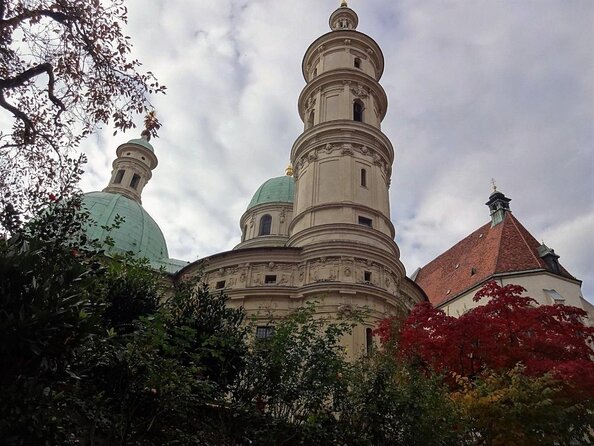
Eggenberg Palace sits right at the edge of Graz’s city center and is set in a park. The pass lets you explore 24 state rooms with original interiors and historical furniture, plus more than 500 ceiling paintings.
That is the kind of fact that signals a time commitment. If you only have one palace day, make it Eggenberg. The sheer number of ceiling paintings means you can’t see everything fast, and you don’t want to. This is a slow-looking stop.
Tradeoff: if you’re short on time and you prefer “sample the highlights,” you may leave feeling like you saw only a slice. That’s okay. The trick is knowing it’s meant to be gradual. Focus on your favorite rooms, and let the rest be for a future visit.
Kunsthaus Graz: contemporary art in a building that looks like it floats
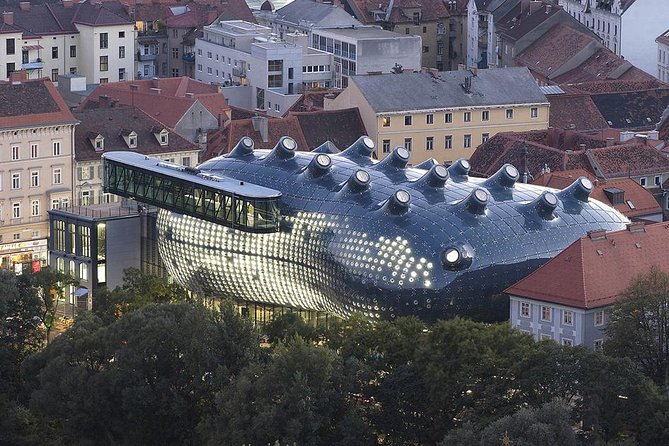
Kunsthaus Graz is a contemporary art museum housed in a building described as floating like a mysterious blue balloon between the roofs of the historic city center.
Even if contemporary art is not always your thing, the building itself is an attraction. It changes how you feel about the neighborhood you’re standing in. You are not just viewing art, you’re also experiencing the contrast between the modern structure and the older streets around it.
Who should go: anyone who wants variety, and anyone who likes architecture-adjacent museum experiences.
Styrian Armoury: the world’s largest historical weapons arsenal
The Styrian Armoury is described as the world’s largest historical weapons arsenal. If weapons and arms history are your interest, you’ll probably want to spend more time here than you do in some other stops.
Even if you’re not a “weapons” person, the size of the collection can be a way to understand how military technology evolved, how materials were used, and how societies prepared for conflict.
How I’d pace it: if Stainz is also on your list, choose one as the deeper emotional time. For many people, the Armoury is the bigger draw, so keep Stainz as a complementary visit rather than another full deep dive.
Price and value: is $24.08 a good deal for 12 admissions?
At about $24.08 per person, the pass can be excellent value, mainly because it groups 12 museums and cultural institutions into one payment. If you use the pass for several sites in your window, your effective cost per admission drops fast.
The value is highest when:
- you actually visit multiple sites within 24 or 48 hours
- you can handle self-guiding, meaning you enjoy making your own call on what to do next
- you’re okay paying extra for guided tours only at the specific place you want help
The value is weaker if:
- you end up doing only one or two museums
- you strongly need guided explanations at every stop
- you dislike paper ticket exchanges and prefer fully digital entry
Also, note that the pass is paper ticket based. That’s not a dealbreaker, but it does affect your prep. The upside is that a paper process often feels more reliable when you bring printed proof.
Ticket handling, language, and practical logistics that can make or break your day
The pass is sold for English-speaking visitors and uses a paper ticket system. You print and bring your Viator booking confirmation to the cashier point to receive the pass. Confirmation is received at booking time, so you can plan around that.
Here’s my practical caution from the kind of issue people run into with digital tickets: don’t wait for an email with a QR code to solve everything. If your plan relies on that email arriving quickly, you risk a headache. Print the confirmation and carry it with you.
Audio guides and guided tours are not included. If you want English interpretation beyond what the museum provides in the room, budget the extra cost for audio guides (2.50 EUR per person), and look for guided tours you can purchase on site.
Good news on ease: it’s near public transportation, service animals are allowed, and most travelers can participate. So you’re not dealing with a complicated access maze.
Who this pass is perfect for, and who should choose something else
This pass is a great fit if you:
- want to see a range of Graz and Styria institutions, not just one museum
- like choosing your own pace
- can do a mix of indoor exhibitions and castle or palace visits
- enjoy variety, from Roman archaeology to natural history to contemporary art
It’s less ideal if you:
- need guided tours included in the price
- only want one museum and have no interest in the rest
- dislike the idea of exchanging a printed confirmation for a paper pass
Should you book the Universalmuseum Joanneum pass?
I’d book it if you’re staying long enough to use the full benefit of the pass window. The real win is choosing your own order across 12 institutions, including heavy hitters like Eggenberg Palace and the Styrian Armoury, plus variety stops like Kunsthaus Graz and the Natural History Museum.
I would not book it if you expect a guided tour experience in the base price, or if you hate paper ticket workflows. But if you’re fine printing your confirmation and building your own route, this is a smart value way to see more of Styria than you could with single-site tickets.
If you do book: pick your anchor stop(s) first, then build around them. That simple step turns a pass into a great day, not a scramble.
FAQ
How long is the Universalmuseum Joanneum Pass?
You can choose a 24-hour or 48-hour pass.
How many museums and exhibits does the pass include?
The pass provides admission to 12 museums and cultural institutions.
Where can I use the pass?
It covers museums and sites across Graz and greater Styria.
Is the pass available in English?
Yes, the pass is offered in English.
Is the ticket paper or digital?
It is a paper ticket, and you exchange your booking confirmation at the cashier point.
Do guided tours come with the pass?
No. Guided tours are not included, but they can be purchased separately on site.
Are audio guides included?
Audio guides are not included and have an additional cost of 2.50 EUR per person.
What do I need to receive the pass?
You must print and show your booking confirmation from Viator at the cashier point to receive your 24- or 48-hour pass.
What is the cancellation policy?
You can cancel up to 24 hours in advance for a full refund.
Is this experience near public transportation?
Yes, it is near public transportation, and service animals are allowed.
Latest Graz reviews
- Kunsthaus Graz Museum Entrance Ticket★ 3.5 · 19 reviews
- Explore Graz in 60 minutes with a Local★ 5.0 · 7 reviews
- Graz Funicular Ride and Schlossberg Picnic Experience★ 5.0 · 5 reviews
- Graz Old Town Highlights Private Walking Tour★ 5.0 · 4 reviews
- Graz Private Walking Tour With A Professional Guide★ 5.0 · 5 reviews
- Graz Scavenger Hunt and Sights Self Guided Tour★ 4.0 · 9 reviews
- Graz city tours★ 3.5 · 9 reviews
- Fun & mobile scavenger hunt through Graz★ 4.5 · 12 reviews
City Passes, compared.

Vienna PASS: All incl. Sightseeing Pass for 85+ Attractions
Read our review →
Vienna FLEXI Pass: Choose from 70+ Top Sights in one Ticket
Read our review →
Vienna PASS Including Hop On Hop Off Bus Ticket
Read our review →
Vienna 3, 4 or 5-Attraction Pass: Schönbrunn, Belvedere, Bus
Read our review →
Best of Vienna Pass: Schönbrunn, Belvedere, Big Bus & Cruise
Read our review →
Schönbrunn, Danube Tower, Boat, Wheel & Hop On – FLEXI Pass
Read our review →
Admission Pass to The Roman Quarter and the Museum Carnuntinum
Read our review →Browse the lists this tour appears in